 Symbiosis
 Octopools for Single-Asset Deposits and Host-Chain Withdrawals
Symbiosis Octopools let liquidity providers supply one supported asset to an automated market maker pool without preparing a matching token pair. That makes them a strong fit for contributing eligible liquidity to cross-chain routing and receiving a share of pool trading fees. The fit becomes conditional on asset support, control of the liquidity provider (LP) tokens on the Symbiosis chain, and the ability to complete the host-chain withdrawal process.
Octopool withdrawals return sTokens on the Symbiosis chain; redeeming those tokens into their corresponding assets requires a separate bridge operation.
Single-Asset Deposits in the v2 Pool Design
Single-sided provision suits a deposit funded with one eligible token type, while the pool itself contains multiple tokens of equal nominal value. Protocol v2 consolidates these cross-chain liquidity pools on the Symbiosis Host Chain. The older v1 arrangement used pools associated with particular blockchain pairs; that version has shut down. Within an Octopool, the single-asset option applies to both liquidity provision and removal. It describes the deposit composition, not a promise of constant market value.
Which Assets Can Enter an Octopool?
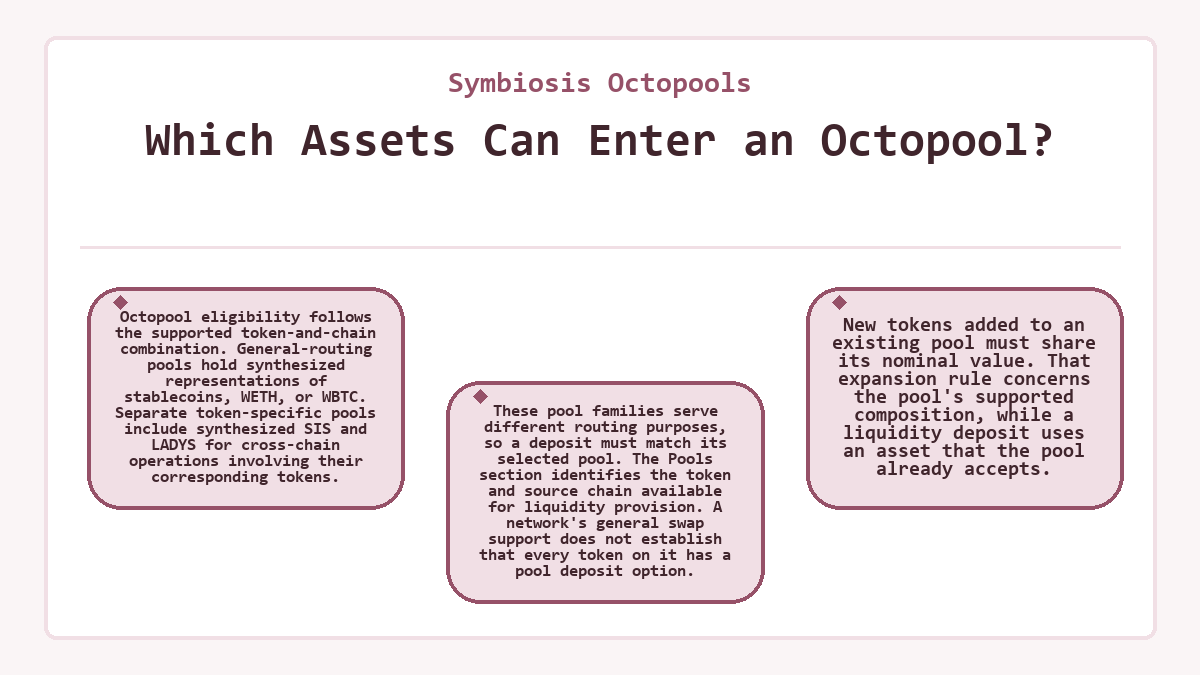
Octopool eligibility follows the supported token-and-chain combination. General-routing pools hold synthesized representations of stablecoins, WETH, or WBTC. Separate token-specific pools include synthesized SIS and LADYS for cross-chain operations involving their corresponding tokens. These pool families serve different routing purposes, so a deposit must match its selected pool.
The Pools section identifies the token and source chain available for liquidity provision. A network's general swap support does not establish that every token on it has a pool deposit option. New tokens added to an existing pool must share its nominal value. That expansion rule concerns the pool's supported composition, while a liquidity deposit uses an asset that the pool already accepts.
LP Tokens and the Host-Chain Receiver
LP tokens represent the supplied liquidity on the Symbiosis chain. For an EVM externally owned account, the default receiver is the same EVM-compatible address on that chain.
Deposits from non-EVM networks require an EVM-compatible LP receiver on Symbiosis. The WebApp permits a custom receiver. The address must be one that the depositor controls on the host chain.
A multisig receiver must exist on Symbiosis and support transactions there before the deposit. The source-network multisig may use a different address.
Does Pooling Offer a Fixed Return?
Octopool fee income varies with pool trading activity, so single-sided entry does not establish a fixed return. Swap fees enter the pool's total liquidity, and liquidity providers receive their proportional fee share when withdrawing. Fee rewards are paid in the sTokens held by the pool. A displayed annual percentage rate, or APR, therefore cannot establish the eventual payout by itself. SIS staking is a separate activity from supplying Octopool liquidity; its reward conditions do not describe the ordinary pool-fee mechanism.
A Single-Asset Deposit With Host-Chain Management
In this hypothetical case, a holder has an eligible token on a supported network other than the Symbiosis chain and controls an EVM-compatible LP receiver on Symbiosis. Assume the selected deposit terms are acceptable and the holder can manage the host-chain position. The intended use is earning pool trading fees while supplying only one deposit asset.
Single-sided provision fits that starting inventory. During a completed standard WebApp deposit, the source asset enters a locking contract. The protocol mints its corresponding sToken on the host chain and adds it to the selected pool. The receiver obtains LP tokens, creating a pool position without requiring a second deposit asset.
My Liquidity shows the completed pool deposit. The holder has supplied one deposit asset while taking on management of a position on another network. If the holder can operate only the source-network wallet, retaining the source asset avoids opening a pool position that they cannot manage on Symbiosis.
How Are Octopool Assets Withdrawn and Redeemed?
An Octopool exit into corresponding assets on another network combines liquidity removal on the host chain with a separate bridge operation for the resulting sTokens. The LP-token holder first needs access to the Symbiosis chain and SIS for gas. A Safe that holds LP tokens needs its own SIS balance.
Removing liquidity returns sTokens on the Symbiosis chain. At that point, the withdrawal has released the pool assets locally; receiving their corresponding assets on another network requires the subsequent bridge operation.
The Bridge function handles that redemption separately from the ordinary Swap function. Each sToken has a corresponding destination token and network. Its redemption path follows that mapping, so the bridge does not offer an arbitrary destination for a given sToken.
The mint-and-burn relationship pairs sTokens one-to-one with their corresponding underlying tokens. A successful redemption burns the synthetic tokens and releases the matching underlying quantity through the Portal contract on its corresponding network.
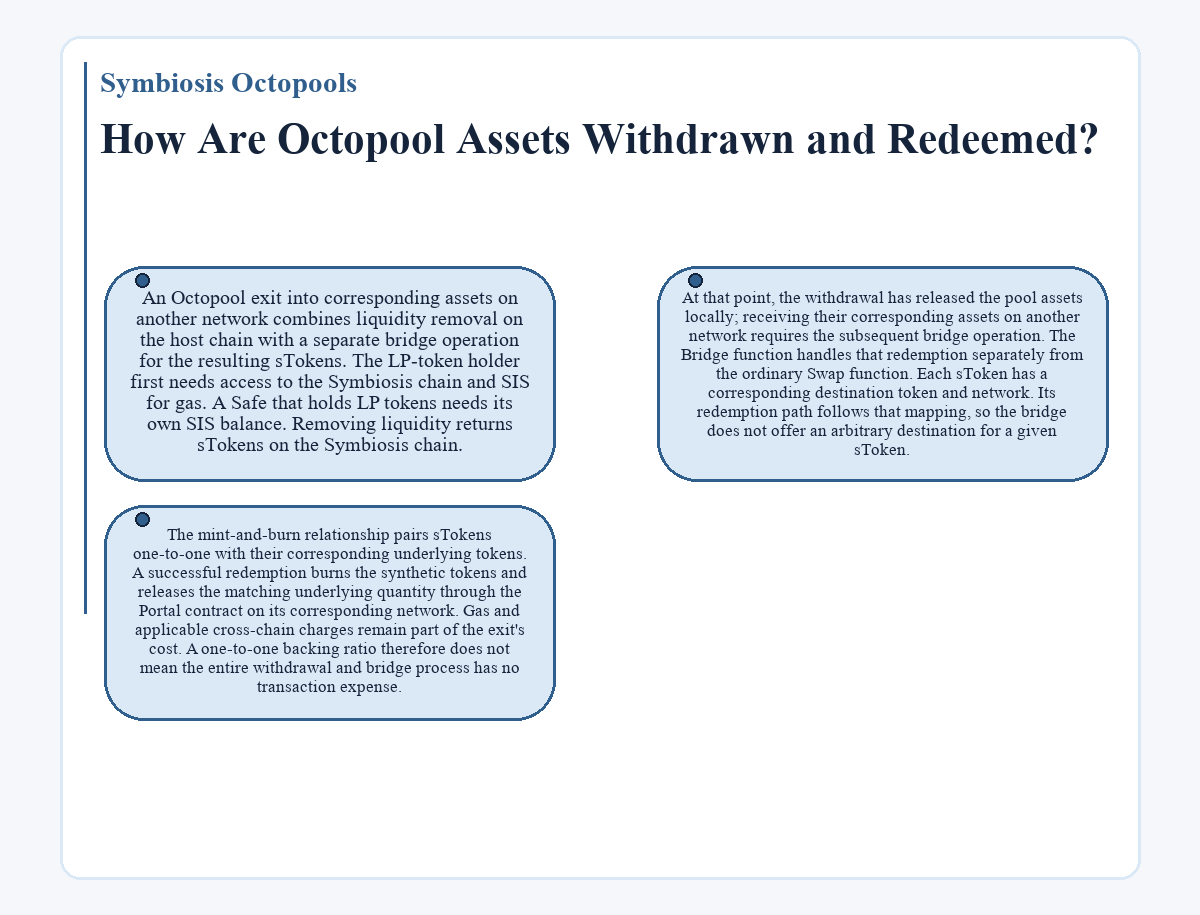
Gas and applicable cross-chain charges remain part of the exit's cost. A one-to-one backing ratio therefore does not mean the entire withdrawal and bridge process has no transaction expense.
Pool Positions Versus Direct Transfers
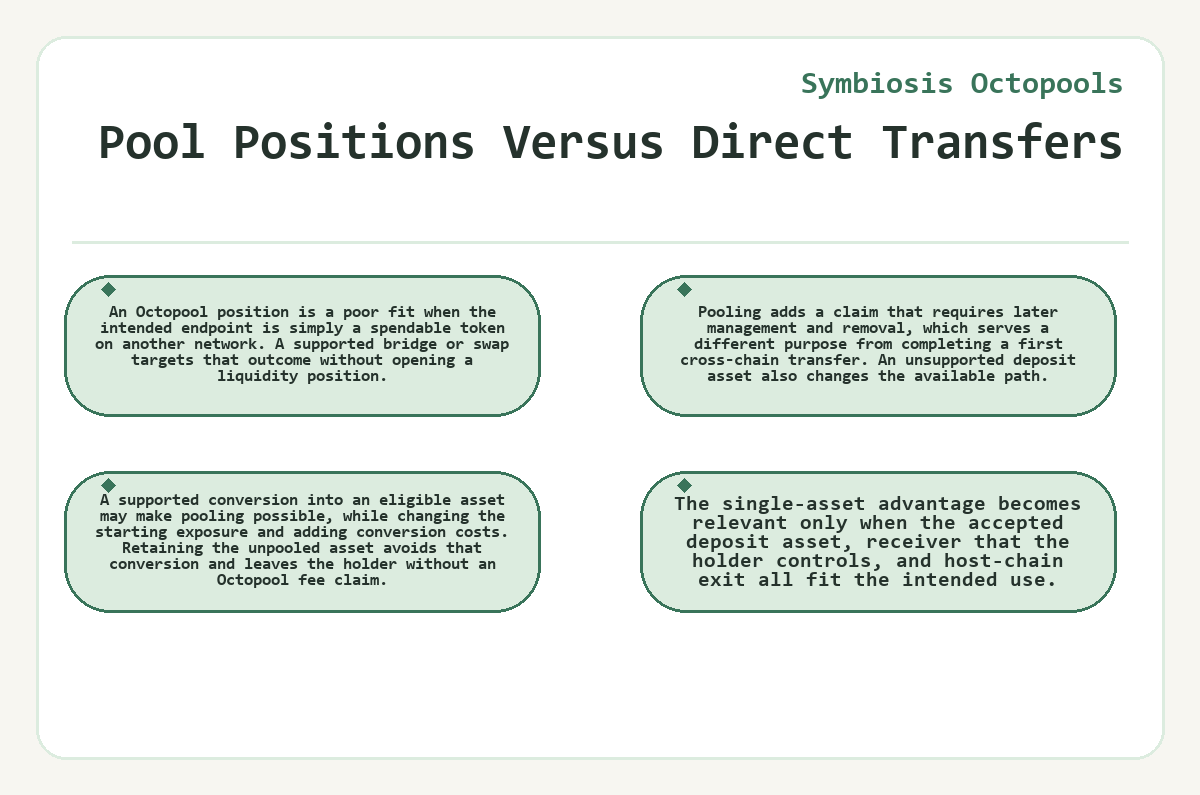
An Octopool position is a poor fit when the intended endpoint is simply a spendable token on another network. A supported bridge or swap targets that outcome without opening a liquidity position. Pooling adds a claim that requires later management and removal, which serves a different purpose from completing a first cross-chain transfer.
An unsupported deposit asset also changes the available path. A supported conversion into an eligible asset may make pooling possible, while changing the starting exposure and adding conversion costs. Retaining the unpooled asset avoids that conversion and leaves the holder without an Octopool fee claim. The single-asset advantage becomes relevant only when the accepted deposit asset, receiver that the holder controls, and host-chain exit all fit the intended use.
Helpful answers about Symbiosis Octopools
Does Approving a Token Add It to an Octopool?
Token approval authorizes a contract to use the asset and does not complete the liquidity deposit. When the WebApp requests approval, it precedes the Add Liquidity action. Pool participation follows completion of that deposit.
Can Octopool Liquidity Be Added Through a Separate Bridge Step?
Manual provision can bridge a supported asset from another network to the Symbiosis chain before adding it to its pool. The standard WebApp deposit combines those stages.
What Does Pool Balance Mean in an Octopool Listing?
Pool Balance is a token's current balance ratio within its Octopool. That ratio affects deposits, withdrawals, and route availability. Total Locked reports tokens locked in the pool.
Are Existing sTokens Eligible for Liquidity Provision?
Supported sTokens can be supplied to their corresponding Octopools on the Symbiosis chain. They are synthetic representations used inside the protocol. The specific sToken determines the applicable pool and corresponding redemption asset.
Where Do Cross-Chain Octopool Deposit Costs Come From?
Cross-chain deposit costs include source-network transaction gas and charges for the protocol's work across networks. The user pays source gas directly; Symbiosis funds later execution and recovers those costs through the transfer. The selected operation's terms determine the applicable charges.
Is a Partial Octopool Withdrawal Supported?
The withdrawal interface supports a selected amount, so removing liquidity need not close the full position. The withdrawn portion produces sTokens on the Symbiosis chain. Redeeming that portion into its corresponding asset remains a separate bridge operation.