 Symbiosis
 staking separates veSIS governance locks from relayer delegation
Symbiosis staking offers SIS holders governance locks through veSIS and relayer participation through Proof of Stake (PoS) delegation. A veSIS lock commits SIS until a chosen expiry and grants voting power. Delegation supports an existing Active validator on Arbitrum One, with activation and rewards governed by epoch changes.
The choice changes where SIS must be held, when participation becomes effective, and how withdrawal works. New validator admission is closed under Safe Mode. Delegation to an existing validator has its own requirement: the validator must be Active.
Key takeaway: A recorded SIS delegation becomes reward-eligible through epoch accounting and relayer participation, while a veSIS lock follows its chosen expiry.
SIS Balances Before a Staking Commitment
PoS participation requires SIS on Arbitrum One. The veSIS locking program supports Ethereum, BNB Chain, zkSync Era, and Linea. Token availability and staking eligibility describe different things: a network that carries SIS does not automatically support every staking mechanism. SIS also has different token contract addresses across networks.
Preparing a balance may involve bridging existing SIS or exchanging another supported asset for SIS on the required network. That acquisition has its own quoted output, price impact, and transaction costs. During Safe Mode, smart contracts also enforce limits on cross-chain operations. A swap that delivers SIS completes the acquisition; it creates no staking position by itself.
Approval and the Commitment Boundary
Token approval grants a contract permission to use SIS within the authorized allowance. The interfaces may request approval before a lock or delegation. Approval alone creates neither position.
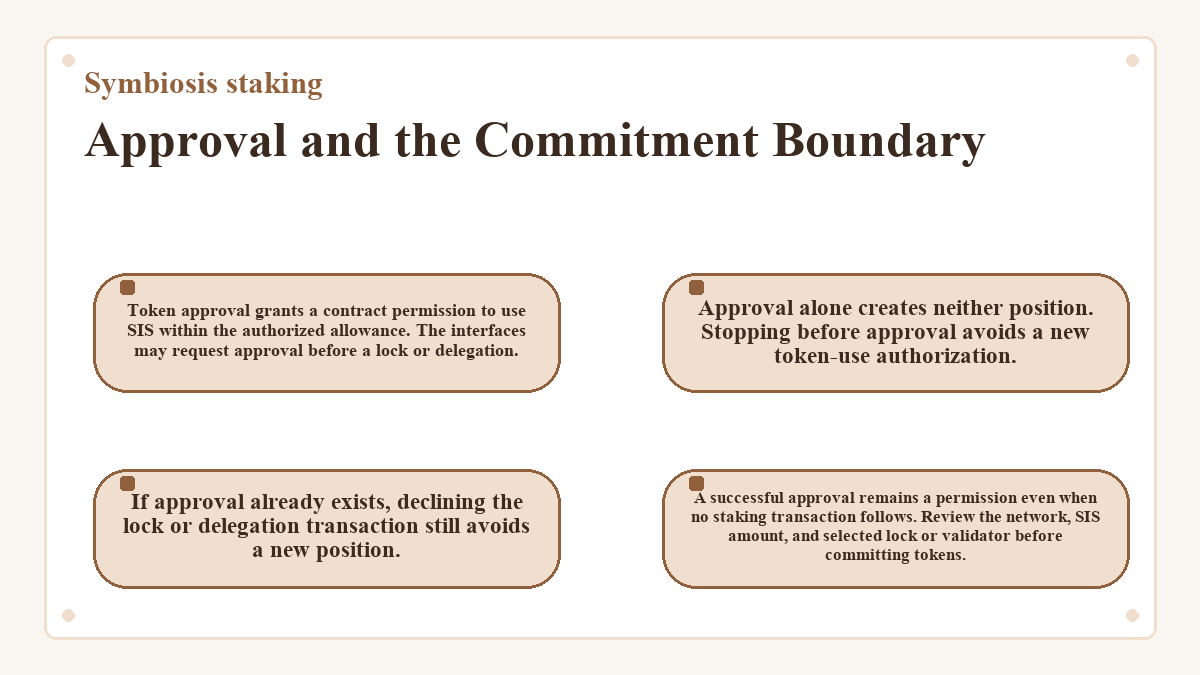
Stopping before approval avoids a new token-use authorization. If approval already exists, declining the lock or delegation transaction still avoids a new position. A successful approval remains a permission even when no staking transaction follows. Review the network, SIS amount, and selected lock or validator before committing tokens.
A First Delegation and Its Recorded Status
A first staking choice starts with the purpose of the SIS commitment. Governance participation, support for an existing validator, and responsibility for a relayer produce different positions and entry conditions.
| SIS Commitment | Recorded Position | Relayer Role and Entry Limit |
|---|---|---|
| veSIS lock | Governance lock with a chosen expiry | No relayer operation required |
| PoS delegation | SIS allocated to a validator | Selected validator must be Active |
| Validator stake | Collateral for a registered relayer | Relayer operation required; new admission closed during Safe Mode |
For a first delegation, hold uncommitted SIS and ETH for gas on Arbitrum One. Connect the wallet holding those funds and examine an existing validator's details. If no eligible Active validator is available, stop before granting token approval.
The Active requirement determines eligibility; the displayed APR estimates an outcome under changing conditions. Select the validator and SIS amount, then review the delegation summary. Approve token use if requested, and confirm the delegation operation.
The Delegator Overview shows the selected validator and delegated amount. A Pending entry identifies a delegation awaiting activation. After checking that the amount and validator match your submission, wait for the epoch change.
What Does veSIS Measure?
veSIS measures voting power that a SIS holder receives by locking tokens for a chosen duration. The vote-escrow model links the initial balance to both the SIS amount and the remaining lock time. Longer commitments provide more initial voting weight for the same SIS amount, with locks extending up to four years.
One veSIS represents one vote in the Symbiosis DAO, its decentralized autonomous organization. The veSIS balance decreases as the lock approaches expiry. That decline concerns voting weight, rather than a scheduled reduction in the original SIS principal. The position can consequently show less veSIS even when its locked SIS amount has not changed.
The veSIS Reward Calendar
veSIS locks earn SIS rewards, distributed weekly on Thursday at 00:00 UTC and collected through a claim transaction. A new lock must accrue for a full reward week before its first allocation. Creating a lock shortly before a distribution therefore does not establish entitlement to that next payment.
Reward estimates also depend on the available weekly allocation and participating balances. The displayed APR, weekly reward, and total reward estimates describe those inputs at calculation time. They do not fix the amount that every later distribution will pay.
When Does a New Delegation Become Active?
A new delegation becomes Active after the relevant epoch change accounts for its tokens. The documented default epoch duration is 24 hours, while actual epochs can differ. That default describes network coordination, rather than an exact personal countdown from submission.
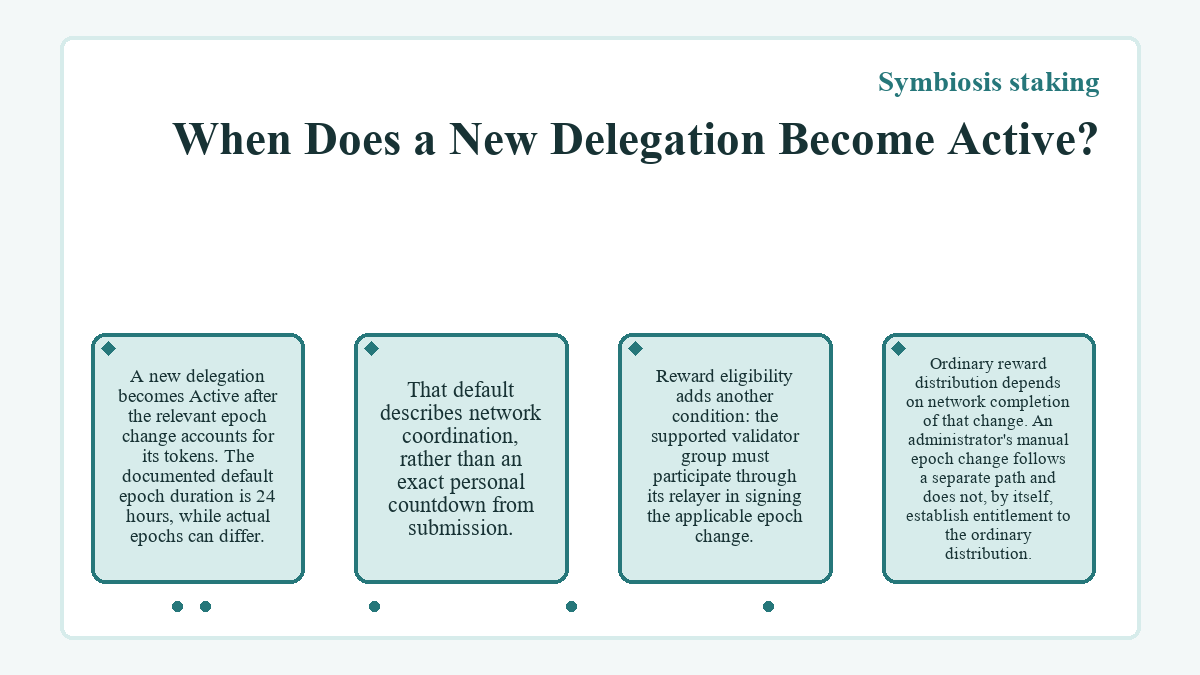
Reward eligibility adds another condition: the supported validator group must participate through its relayer in signing the applicable epoch change. Ordinary reward distribution depends on network completion of that change. An administrator's manual epoch change follows a separate path and does not, by itself, establish entitlement to the ordinary distribution.
PoS Reward Shares and Manual Claims
PoS reward rules allocate an epoch pool among eligible validator groups in proportion to their combined validator and delegator stakes. The pool also adjusts for actual epoch duration relative to the configured default. Contract parameters determine the reward pool, so a quoted annual rate can change.
PoS rewards are paid in SIS, and the documented split assigns 7.5% of the group's reward directly to its validator. The remaining 92.5% goes to both the validator and delegators in proportion to their stakes. These percentages apply to the group reward, not deposited SIS. Validator rewards automatically increase stake; delegators claim rewards manually without automatic compounding. Allocated rewards become claimable after the following epoch change.
Validator Availability and Blocking
Validator status determines whether a listed relayer can accept delegation and participate in network operations. Registered means that registration has completed but the node has not established uptime. Active indicates participation with positive uptime. Offline identifies an unavailable node, while Inactive indicates that the validator has withdrawn its stake. Offline status leaves staked and delegated SIS withdrawable under the applicable withdrawal rules.
Blocking addresses relayer misbehavior in the native PoS mechanism. A blocked node cannot participate in network operations or receive rewards. Delegation therefore carries an ongoing dependency on the selected relayer's operation. An Active label at entry does not promise uninterrupted participation through every later epoch.
Delegators may support multiple validators, and each supported group has its own participation record. Splitting a position changes its exposure across relayers; it does not remove the contracts or reward conditions that those delegations share.
Lock Changes and Withdrawal Boundaries
A veSIS lock retains its SIS principal until its chosen term ends. Adding tokens or extending the expiry changes that commitment. A longer extension postpones the point when the underlying SIS becomes withdrawable, even if the holder has already claimed earlier rewards.
At expiry, veSIS reaches zero and the locked SIS becomes available for withdrawal. The withdrawal instructions require claiming outstanding rewards first. Claiming rewards and recovering the original principal have separate effects; the ability to claim rewards during a lock does not provide early access to its SIS.
Native PoS and delegated staking use an unbonding delay for unstaking. The default epoch duration does not establish that delay's length. A delegation's activation state therefore answers a different question from the date when an exit can finish.
Fee Discounts and Separate Liquidity Positions
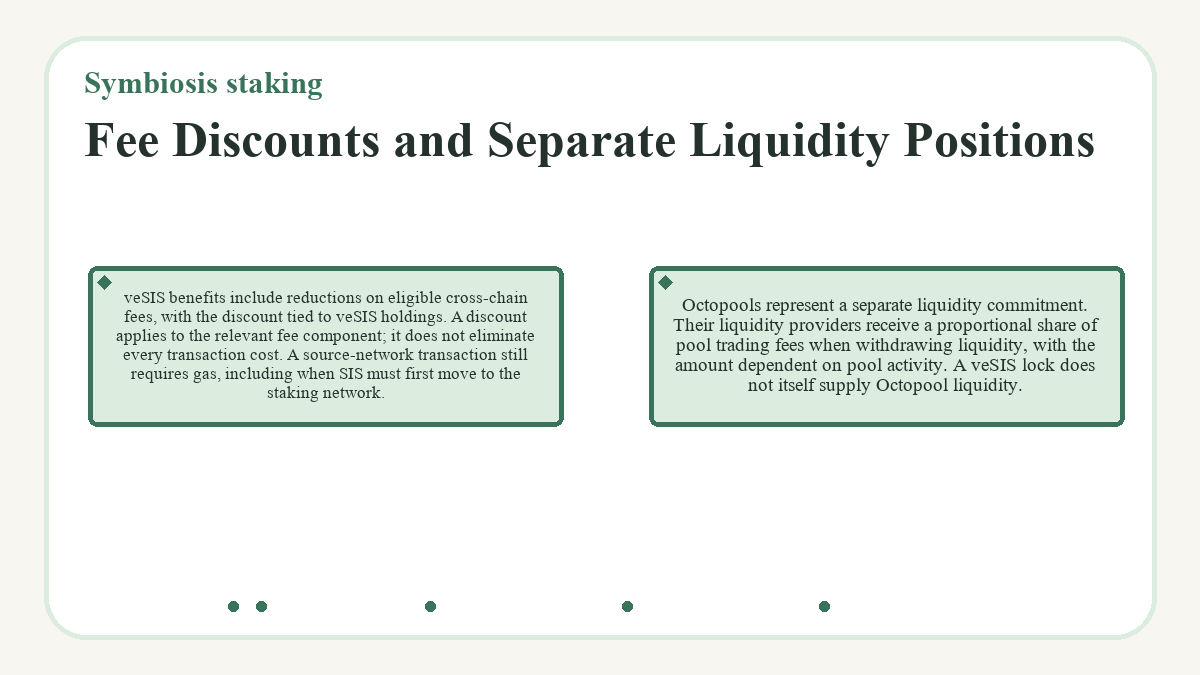
veSIS benefits include reductions on eligible cross-chain fees, with the discount tied to veSIS holdings. A discount applies to the relevant fee component; it does not eliminate every transaction cost. A source-network transaction still requires gas, including when SIS must first move to the staking network.
Octopools represent a separate liquidity commitment. Their liquidity providers receive a proportional share of pool trading fees when withdrawing liquidity, with the amount dependent on pool activity. A veSIS lock does not itself supply Octopool liquidity.
Ethereum Restaking and Its Separate Exit Rules
The SIS Restaking Vault uses Symbiotic infrastructure on Ethereum, adding collateral that supports the Symbiosis Relayers Network. It is a separate contract choice from native PoS delegation on Arbitrum One. Symbiotic can slash allocated vault collateral for misbehavior, while native PoS uses blocking.
The SIS vault's withdrawal guidance allows for a delay of 7-14 days. That range belongs to the Ethereum vault and does not define Arbitrum delegation withdrawals. Selecting a staking contract therefore determines the network holding the commitment and the exit conditions that govern access to its SIS.
Frequently asked questions
-
Can veSIS Be Transferred to Another Wallet?
- veSIS is non-transferable and cannot be traded or moved to another wallet. It represents the voting weight attached to a SIS lock. The underlying SIS becomes withdrawable after the lock expires, so transferring veSIS cannot provide a way to exit that commitment early.
-
Are Validators Allowed to Delegate SIS to Other Validators?
- A Symbiosis PoS validator cannot delegate SIS to other validators through its validator role. Delegators can support multiple validators, while each validator supports one relayer node.
-
How Do veSIS Locks on Multiple Networks Affect Voting Power?
- Locks on multiple supported networks count together for a wallet's voting power and fee discounts. The underlying SIS commitments remain on their respective networks. Managing an existing lock requires selecting the blockchain where it was created, so changing one position does not automatically modify a lock on another network.
-
Will Adding SIS Also Extend My veSIS Lock?
- Adding SIS and extending a veSIS lock require separate operations in the described lock-management interface. The amount control increases the locked principal, while the time control extends the commitment. Review which change a transaction authorizes, because adding tokens and postponing expiry have different effects on access to SIS.
-
What Happens If veSIS Rewards Remain Unclaimed for More Than 50 Weeks?
- Claiming more than 50 weeks of veSIS rewards requires multiple claims because each claim has a maximum time depth of 50 weeks. That limit controls the history one claim processes; it does not establish a reward-expiry deadline. Outstanding rewards must also be claimed before withdrawing SIS from an expired lock.
-
Do Symbiosis DAO Votes Require the Same Token Approval as a veSIS Lock?
- Casting a DAO vote uses a wallet signature to prove voting power and does not require a paid on-chain voting transaction. Creating the underlying veSIS lock involves separate token-use and locking operations. A governance signature therefore has a different purpose from authorizing a contract to spend SIS.