 Symbiosis
 lets you compare a first route before committing assets
Symbiosis lets you assess a first cross-chain swap by checking token compatibility, quoted output, and execution conditions. Its WebApp shows rates without wallet connection. The choice also depends on gas requirements, acceptable price movement, and the ability to confirm the intended asset on the destination network.
In short: Minimum received covers a fully executed swap; a transit-token fallback can leave the intended destination-token conversion unfinished.
Compatibility Before Wallet Connection
The intended destination determines whether the task calls for an on-chain or cross-chain exchange. An on-chain swap changes tokens within one network. A cross-chain route moves value between networks, subject to support for the selected assets. To review a first quote without connecting a wallet, select the source and destination networks and tokens, then enter the intended amount. Wallet-connected routes need compatibility with the source network and the means to pay its transaction costs. Swaps from Bitcoin use a separate deposit-based flow. The displayed quote describes available terms for the selected amount; it does not confirm wallet readiness.
Which Swap Mode Fits Your First Route?
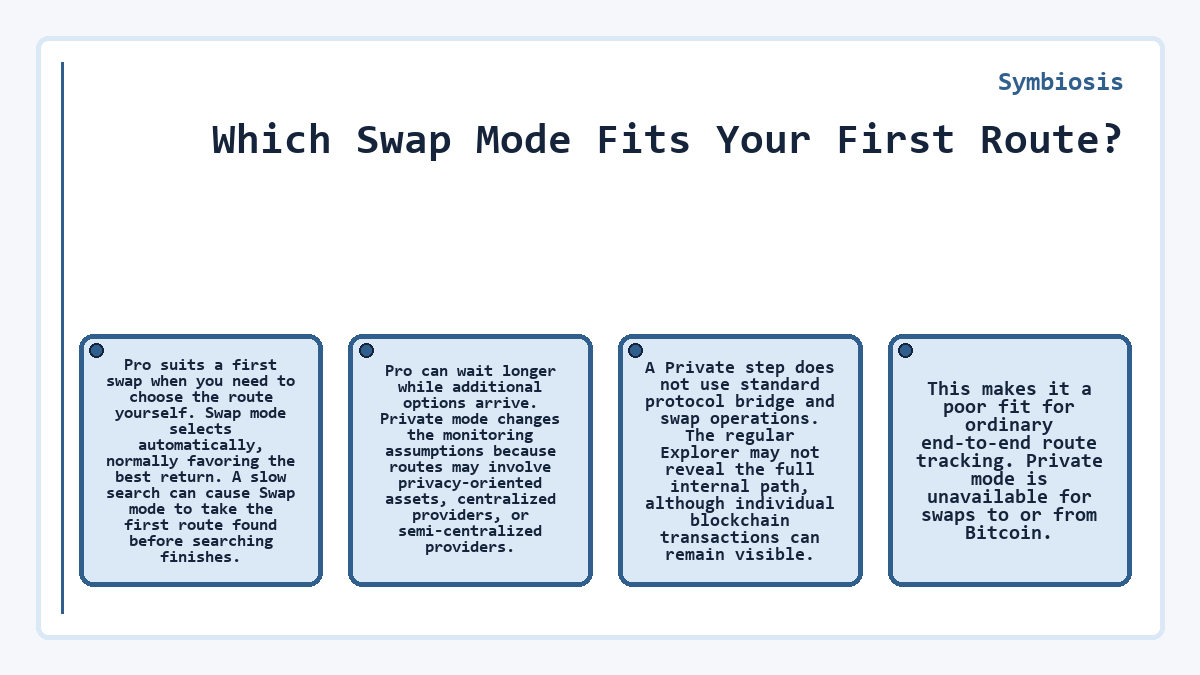
Pro suits a first swap when you need to choose the route yourself. Swap mode selects automatically, normally favoring the best return. A slow search can cause Swap mode to take the first route found before searching finishes. Pro can wait longer while additional options arrive.
Private mode changes the monitoring assumptions because routes may involve privacy-oriented assets, centralized providers, or semi-centralized providers. A Private step does not use standard protocol bridge and swap operations. The regular Explorer may not reveal the full internal path, although individual blockchain transactions can remain visible. This makes it a poor fit for ordinary end-to-end route tracking. Private mode is unavailable for swaps to or from Bitcoin.
Quote Parameters and Their Limits
Standard swap quotes describe the selected exchange and its price conditions. Their values change with the amount and available route, so they are not permanent transfer terms.
| Parameter | Value in the Quote | What It Applies To |
|---|---|---|
| To amount | Estimated token quantity | Selected destination token and network |
| Minimum received | Output floor for a fully executed route | Requested destination token; excludes a transit-token fallback |
| Slippage tolerance | Configured percentage | Accepted price movement across the swap |
| Fee | Estimated route fee | Excludes the source-chain transaction fee |
| Estimated time | Estimate based on historical data | Expected completion of the selected cross-chain exchange |
Minimum Output and Transit Token Delivery
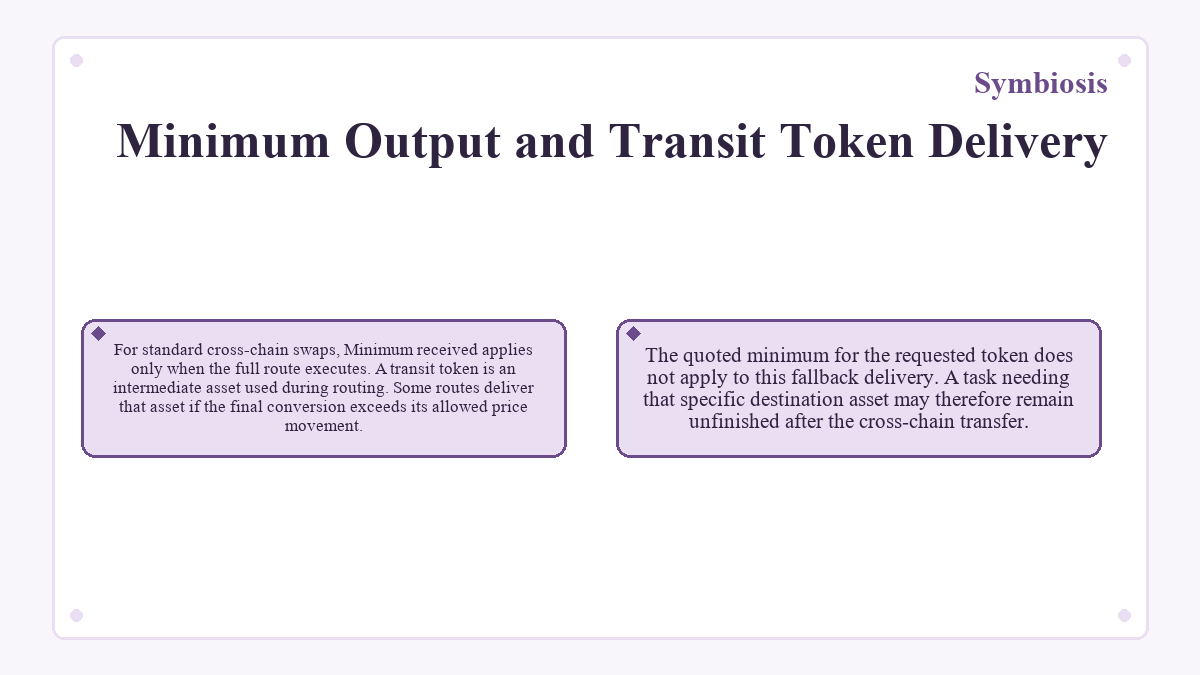
For standard cross-chain swaps, Minimum received applies only when the full route executes. A transit token is an intermediate asset used during routing. Some routes deliver that asset if the final conversion exceeds its allowed price movement. The quoted minimum for the requested token does not apply to this fallback delivery. A task needing that specific destination asset may therefore remain unfinished after the cross-chain transfer.
Timing, Gas, and the Signing Boundary
A strict arrival deadline cannot rely solely on an estimated duration. Standard cross-chain swaps usually take 1-3 minutes; Bitcoin swaps can take longer. The estimate reflects historical data.
The source wallet covers the initial network transaction cost separately from the displayed route fee. Where the network charges that cost in its native token, the sending wallet needs enough of that token.
Relayers pay gas for later transactions on protocol-operated routes, and the protocol recovers those costs from transferred tokens. These deductions affect destination output; the source transaction fee remains a separate payment.
Transfer size changes the cost comparison. Cross-chain fees can absorb a larger share of a small transfer, while available liquidity affects price impact. Evaluate the destination-token quantity for the amount actually being considered. Scaling an earlier quote proportionally can hide those effects.
For standard protocol-operated routes, signing fixes fees, slippage conditions, and any applicable execution deadlines. A submitted operation cannot be edited like an unsigned quote. If the task requires freely changing those terms, stop at quote review before accepting the transaction.
Confirmation on the Destination Network
Standard cross-chain routes suit a task that allows monitoring until delivery or another recorded outcome. Symbiosis Explorer supports searches by transaction hash or wallet address. An identifier locates the operation; it does not certify delivery. Success means the swap completed, while Success* indicates transit-token delivery in place of the requested token.
Completion for the intended use means the correct asset reaches the selected address on the intended network. Read the destination transfer, token, and amount alongside the operation status. An In progress state means processing continues.
A Swap Balance or a Protocol Position
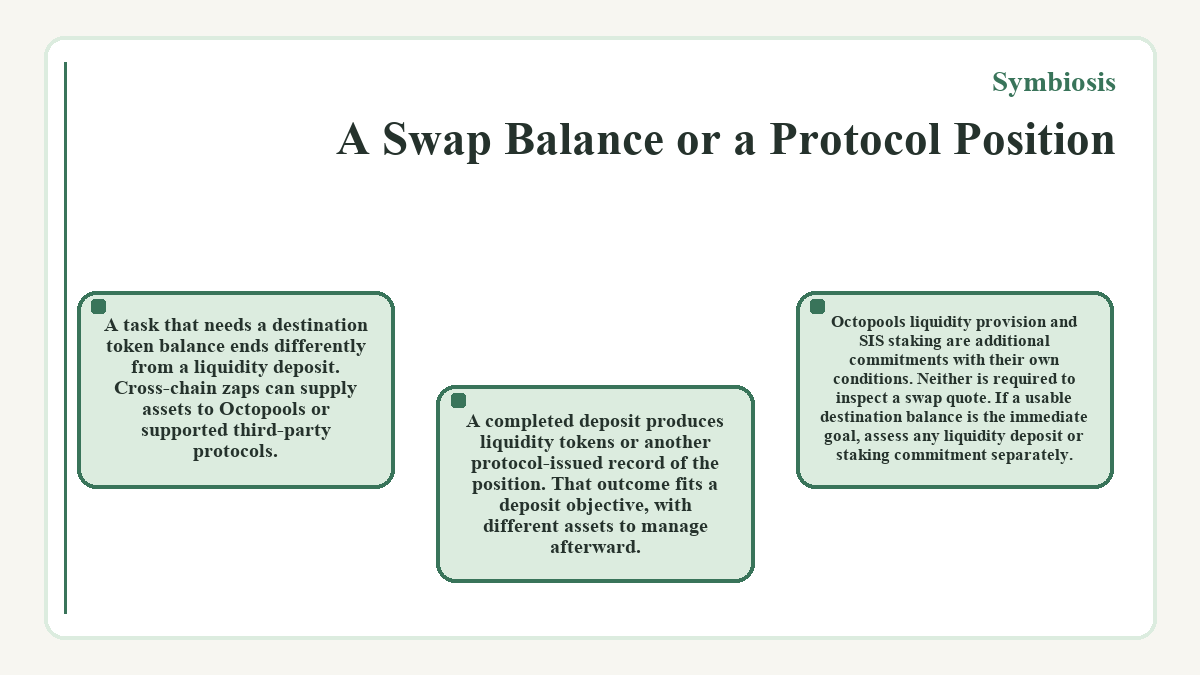
A task that needs a destination token balance ends differently from a liquidity deposit. Cross-chain zaps can supply assets to Octopools or supported third-party protocols. A completed deposit produces liquidity tokens or another protocol-issued record of the position. That outcome fits a deposit objective, with different assets to manage afterward.
Octopools liquidity provision and SIS staking are additional commitments with their own conditions. Neither is required to inspect a swap quote. If a usable destination balance is the immediate goal, assess any liquidity deposit or staking commitment separately.
Popular questions about Symbiosis
-
Does a First Swap Require Token Approval?
- An ERC-20 input can require approval to MetaRouterGateway in the standard routing flow on Ethereum Virtual Machine (EVM) networks. Native source assets skip that step. Approval permits spending; it does not deliver the destination asset. The swap transaction remains a separate confirmation in this flow.
-
Will Changing Liquidity Sources Alter My Available Routes?
- Disabling a liquidity source can remove routes for the selected tokens and networks. The setting changes which sources the WebApp may use. An absent option after that change does not by itself establish that the token or network is unsupported.
-
Is a Bitcoin Wallet Connection Required for a First BTC Swap?
- Swaps from BTC use a unique deposit address rather than the ordinary connected-wallet flow. The destination address can come from a connected wallet or manual entry. That deposit address belongs to the specific swap. Sending a different amount, exceeding its time limit, or reusing the deposit address can stop the swap.
-
Does Setting Zero Slippage Make the First Swap More Reliable?
- Zero slippage tolerance leaves no room for an unfavorable price movement between the quote and execution. Even a small change can prevent the exchange from proceeding. A tighter limit restricts the accepted price movement; it does not remove the time between transaction submission and confirmation.
-
Where Can I Track a First Swap That Stays on One Blockchain?
- An on-chain swap can be tracked directly in the block explorer for its network. The transaction hash identifies that network transaction. This differs from following a cross-chain operation through several networks, so the network explorer is the appropriate starting point for a swap that never changes chains.
-
What Information Helps Support Locate a First Swap?
- The transaction hash and sender's wallet address help support identify the operation. Include the tokens and networks involved, a brief description of the issue, and relevant screenshots. Keep recovery phrases and private keys out of every support message.
-
When Can a Destination Exchange Wait for Another Attempt?
- Routes using a deployed Depository can retain transit assets while the Solver retries a failed destination exchange. For locks with an optimistic output target, immediate release requires meeting that target. Delayed release follows a time-dependent acceptable range that never falls below the fixed minimum. If an acceptable conversion remains impossible, the fallback releases transit tokens to the recipient. This flow is not deployed on every supported network.
-
Are Partner Apps Identical to the Symbiosis WebApp for a First Swap?
- Partner applications can use the protocol through their own interfaces. Shared infrastructure does not establish identical controls or route presentation. The WebApp's wallet selection, settings, and history describe that particular interface, so their presentation should not be assumed for every partner application.